Part 1. What a torpedo is and how it works
1.1 What a torpedo is and how it is built
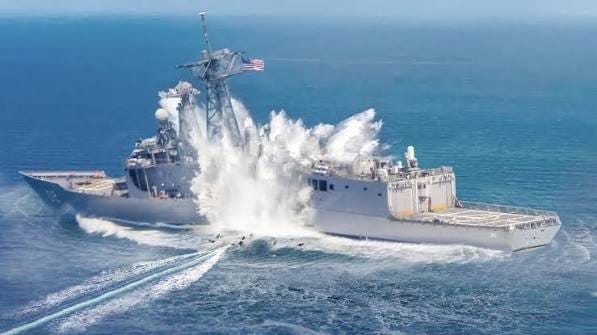
A torpedo is a self propelled underwater weapon that carries its own power, its own sonar and its own warhead, and steers itself onto a movingg target. It does the job of a guided missile in a medium where radio, radar and light dont work well.
Two size classes. Lightweight torpedoes are 324 mm across and weigh a few hundred kg. We can drop them from aircraft or heli or fire from ship tubes.
India’s Shyena (220 kg) and the US Mk 54 are lightweights. Heavyweight torpedoes are 533 mm weigh about 1.5 to 1.9 tonnes, and are fired from submarine and ship tubes. They carry 200-300 kg of explosive….Varunastra, the US Mk 48 and the German DM2A4 are heavyweights.
Two ways to power. Electric torpedoes (Varunastra, DM2A4, F21, Black Shark Advanced) run on a battery and a motor. They are quiet and leave no exhaust trail. Thermal torpedoes burn fuel in an engine: the Mk 48 runs a piston engine on Otto Fuel II, and Russia’s UGST and Britain’s Spearfish are thermal too. Thermal ones give more speed and range, but they are louder.
Explaining whole nose to tail.
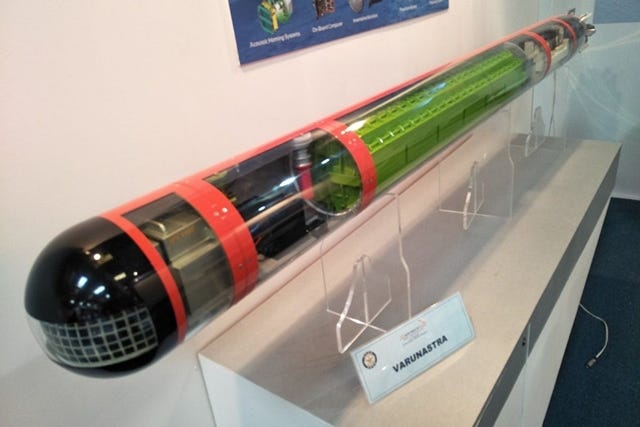
Homing head: a curved array of sonar transducers behind the nose cover. It sends and receives sound.
Signal processor: the computer that helps identify echoes and noise into decisions about what is a target.
Warhead and fuze: 200-300 kg of high explosive in a heavyweight. Modern charges are insensitive, meaning fire, shock or a nearby blast will not set them off. The fuze combines contact and proximity (magnetic or acoustic) triggers so it can fire under the keel….and the way it breaks is also interesting… won't talk much but it forms a massive bubble that plays a majoe role to break the warship :))
Guidance and control: gyroscopes and accelerometers track position+ a depth sensor holds depth, and an autopilot moves the fins.
Energy section: a battery pack or a fuel tank. It is the longest and heaviest section.
Motor and propulsor: a motor turns propellers or a pumpjet. Germany’s DM2A4 uses a permanent magnet motor and France’s F21 a contra rotating propeller.
Tail: control surfaces